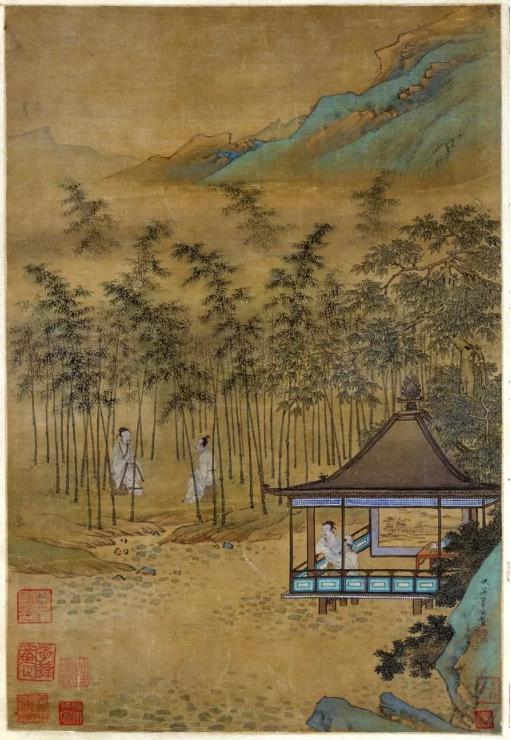
Qiu Ying
Introduction
Qiu Ying (1494-1552) was one of the most renowned painters from the Ming Dynasty in China. He is celebrated for his exquisite brushwork and the detailed precision of his paintings, which often depicted idyllic landscapes and serene scenes of Chinese life. Qiu Ying was recognized as one of the "Four Masters of the Wu School" of the Ming Dynasty, a painting movement based in Suzhou, Jiangsu province. This group, which also included artists Shen Zhou, Tang Yin, and Wen Zhengming, was known for its unique style that often highlighted gardens and landscapes of the Jiangnan region, located south of the Yangtze River. Although Qiu Ying was not born into a scholarly family, he achieved great acclaim through self-training and cultural immersion.
Early Life
Qiu Ying was born in Taicang, Jiangsu province, and later moved to Wujun prefecture, now known as Suzhou. Despite his humble beginnings, Qiu Ying's talent as a painter became evident at a young age. Unlike many of his contemporaries who were born into scholarly families, Qiu Ying's journey as an artist was largely self-directed. He learned through observation and practice, often drawing inspiration from the natural beauty of his surroundings in Jiangsu province. His early life was marked by his dedication to mastering the art of painting, and he spent countless hours honing his skill. This commitment to his craft eventually led him to rise as one of the leading figures of the Wu School of painting.
Artistic Career
Qiu Ying's artistic career is characterized by his profound influence on Ming Dynasty art and his mastery of both figure and landscape painting. His works often depicted scenes of tranquility and reflection, drawn from a deep appreciation for the natural world and traditional Chinese culture. Qiu Ying's career flourished as he became known for the elegance and precision of his brushwork, his use of vibrant colors, and his ability to convey a deep sense of serenity through his paintings.
Influences and Style
Qiu Ying's style was heavily influenced by his environment and the prevailing trends of the Wu School. The Wu School artists were known for their detailed depictions of nature and landscapes, which were often characterized by their lyrical and poetic qualities. Qiu Ying's paintings, like those of his Wu School contemporaries, frequently featured lush gardens, rolling hills, and serene water scenes. His meticulous attention to detail and his ability to capture the essence of his subjects set his work apart. Qiu Ying was also known for his narrative scenes and portraits of Buddhist deities, which he executed with a graceful hand and a keen eye for detail.
Notable Works
Among Qiu Ying's most notable works is the painting Bamboo and Paulownia in Summer, which beautifully captures the essence of a tranquil summer day. The piece depicts lush bamboo groves and distant verdant mountains, creating a scene of calm and relaxation. Another significant work is Immortal Realm of the Peach Spring, inspired by the prose Taohuayuan Ji by Tao Yuanming. This painting visualizes an idyllic land of peace and harmony, with rich use of green and blue pigments. Qiu Ying was highly regarded for his ability to translate the subtleties of nature and human emotion into his paintings, making his works enduringly popular.
Legacy and Influence
Qiu Ying's legacy as an artist of the Ming Dynasty is significant. He is remembered not only for his technical skill and aesthetic contributions but also for his influence on subsequent generations of artists. His works have been preserved and celebrated in various museums and exhibitions, highlighting their historical and cultural importance. As one of the "Four Masters of Wu School," Qiu Ying helped shape the trajectory of Chinese art, offering a style that balanced traditional techniques with innovative expressions of beauty and tranquility. His impact is evident in the continued appreciation of his works, both in China and internationally, as they offer a window into the rich artistic heritage of the Ming Dynasty.








